What is Critical Thinking?
What do we mean when we talk about Critical Thinking?
Critical thinking is, on the one hand, the ability to think reflectively and independently, as well as to formulate clear and rational thoughts.
It is an active and systematic process aimed at analyzing, evaluating, and interpreting information.
The goal: to make well-informed decisions for ourselves, our fellow humans, and our environment.
At its core, critical thinking means thinking independently. It involves:
- Analyzing ideas and arguments
- Evaluating arguments and claims
- Questioning assertions
- Drawing conclusions and finding alternatives
- Maintaining an open mind (without falling into naivety)
- Constructively doubting
- Thinking for oneself to form personal opinions and make personal decisions
Critical Origins
From Kant's Critique of Pure Reason, through a critical point to the critical times we live in, "critical" is everywhere and multifaceted.
It comes to us partly via the French "critique", which gives us "critical" and "criticism".
Originally from the Latin "criticus". The Romans, as often, borrowed it from the Greeks, where it is "κριτικός" (kritikos) and means "capable of distinction" or "judgmental". It is related to κρίσις (crisis) and derived from the verb "krinein", which means: "to distinguish", "to select", "to decide", "to sift".
Critical Thinking as Metacognition
Metacognition? Meta what? It sounds fancy and academic, but it's simply thinking about thinking. Philosophers call it "taking the meta-level," and since we're talking about cognition, it's meta-cognition.
We should simply ask ourselves more often when we think well and when we go astray, and why.
One of the wisest old philosophers (another Greek) demonstrated this with his dialogues, which his student Plato recorded.
"I know that I know nothing"
literally: "For I myself knew that I knew nothing at all ..."
Socrates in Plato: Apology of Socrates 22d
Skills and Attitudes of Critical Thinking
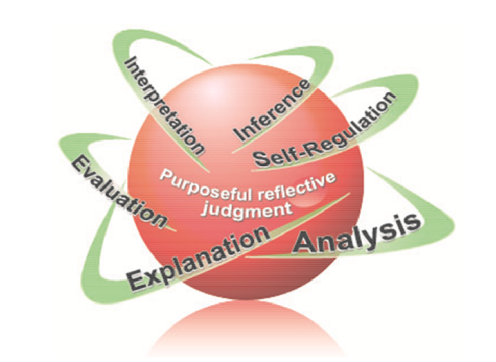
Peter Facione, in his well-known "Delphi Report," following the many participating experts, primarily distinguished two things:
Cognitive Skills vs. Affective Attitudes
The cognitive skills include:
- Interpretation: The ability to understand information, statements, or data and grasp their meaning in the respective context.
- Analysis: The ability to break down arguments, claims, or problems into their components and recognize their structure and relationships.
- Evaluation: The ability to critically examine and assess the credibility of statements, arguments, or sources.
- Inference: The ability to draw logical conclusions from available information and derive hypotheses.
- Explanation: The ability to clearly and comprehensibly present and justify one's own thoughts, arguments, and conclusions.
- Self-Regulation: The ability to monitor one's own thinking, recognize errors, and correct the thought process when necessary.
Attitudes (Affective Side)
In addition to cognitive skills, Facione emphasizes affective attitudes (affective dispositions) as the second important aspect of critical thinking.
These include attitudes such as:
- intellectual curiosity,
- open-mindedness,
- fairness,
- intellectual humility,
- courage to seek the truth,
- perseverance,
- the willingness to question one's own biases1
I've highlighted the points that are rarely mentioned but are most important.
Who doesn't know very intelligent people, with all cognitive skills (scientists, philosophers, business leaders), who fail because they are unable to question their own truths?
These attitudes foster a constructive, self-critical, and open mindset.
These attitudes help you:
- Orientation: They help you avoid blindly going astray.
- Collaboration: They help you work with people who have different opinions.
- Self-Correction: They help you say, "Oops, I was wrong."
- Change: They help you grow and develop further.
Critical thinking is not an innate ability but must be learned and continuously developed.
It requires practice, self-reflection, and the willingness to question one's own thought processes.
Let's get started!
Sources
- Critical Thinking, Wikipedia
- Critical Thinking, Stanford Encyclopedia of Philosophy
- Peter A. Facione: Critical Thinking: A Statement of Expert Consensus for Purposes of Educational Assessment and Instruction., Santa Clara University 1990.
- Peter A. Facione: Critical Thinking: What It Is and Why It Counts, 2015